Difference between revisions of "Mackie Documentation"
(Added text description of Mackie Channel) (Tag: VisualEditor) |
(→Overview) (Tag: VisualEditor) |
||
| Line 12: | Line 12: | ||
<gallery> | <gallery> | ||
Mackie_Channel_Flow_w_Direct.pdf | Mackie_Channel_Flow_w_Direct.pdf | ||
| − | </gallery> | + | </gallery>This document is a block diagram showing the signal path through a single channel on a Mackie analog mixer — tracing how audio travels from the input jack through the channel's processing stages and out to the various destinations (main stereo outs, sub groups, direct out, and aux sends). |
| − | + | ||
| − | + | ||
| − | This document is a block diagram showing the signal path through a single channel on a Mackie analog mixer — tracing how audio travels from the input jack through the channel's processing stages and out to the various destinations (main stereo outs, sub groups, direct out, and aux sends). | + | |
== The Main Signal Path == | == The Main Signal Path == | ||
Revision as of 14:08, 16 April 2026
Contents
Full Manual
Channel Print-Out
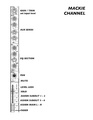
Mackie Channel Signal Flow

The Main Signal Path
Audio flows left-to-right through the channel strip in this order:
- INPUT — the physical jack where your source (mic, instrument, line-level device) enters the channel
- TRIM — input gain stage that sets the proper signal level for the channel
- INSERT — send/return point for patching in external processing (compressors, effects, etc.)
- LOW CUT — high-pass filter to remove low-frequency rumble
- EQ — tone-shaping equalizer
- MUTE — a switch that silences the channel when engaged
- FADER — the channel volume control
- PAN — places the signal in the stereo field (left-to-right)
- ASSIGN — routes the post-fader signal to the chosen stereo output bus
Output Destinations
After the assign stage, the signal can be sent to any of the Stereo Outs:
- L/R — the main mix output
- 1/2 — subgroup bus 1/2
- 3/4 — subgroup bus 3/4
A channel can be assigned to any combination of these buses simultaneously.
The Direct Out
A Direct Out tap is taken immediately after the fader (post-fader, post-mute), providing a mono feed of that single channel. This is useful for multitrack recording — each channel can be sent to its own recorder input independently of the main mix.
Aux Sends and the Pre/Post Switch
The channel feeds two auxiliary sends, AUX 1 and AUX 2, which are commonly used for monitor mixes or effects sends. A PRE SWITCH determines where the aux send taps the signal from:
- "PRE" signal — taken before the fader and mute (after EQ). The aux send level is independent of the channel fader — useful for stage monitor mixes, where the performer's monitor level should stay constant even when the front-of-house fader moves.
- "POST" signal — taken after the fader and mute. The aux send level follows the fader — useful for effects sends (reverb, delay), so the effect level tracks the channel's mix level.
Each aux send has its own level knob (shown as AUX 1 and AUX 2 with their rotary controls) before going to the aux output buses.
Summary
A signal entering the channel is gained, filtered, EQ'd, muted (or not), and faded — then it splits three ways: to the assign matrix for the main stereo/subgroup mix, to the direct out for isolated recording, and to the aux sends (pre- or post-fader) for monitors and effects.